
 Cocoa Market Report
Africa’s Cocoa Market Report
A strategic look at Africa’s cocoa value chain, where production strength meets missed value, processing gaps, and major investment opportunity.
Africa produces most of the world’s cocoa, yet captures only a small share of the wealth created from it. The continent’s cocoa story is not only about farming more beans. It is about earning more from what Africa already produces.
The Africa’s Cocoa Market Report examines the cocoa value chain from production to processing, finished products, margins, and investment opportunities. It highlights the gap between Africa’s production dominance and its limited value retention.
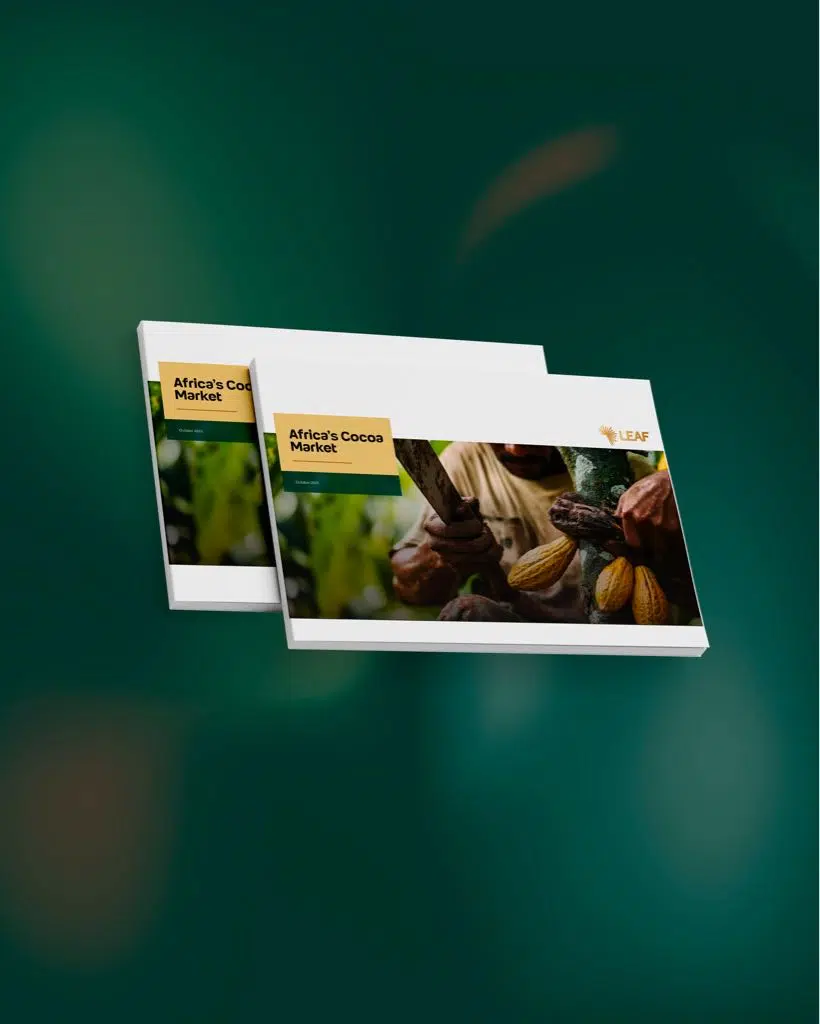
A closer look at Africa’s cocoa value chain.
A flagship LEAF report built to help investors, policymakers, entrepreneurs, agribusiness leaders, processors, researchers, and development partners understand where Africa’s cocoa value is being lost and where opportunity can be captured.
The report explores Africa’s cocoa production, the processing gap, value-chain economics, missed export opportunities, finished-product potential, actor roles, unit economics, and comparative margins.
Africa’s cocoa story is a value-capture problem.
Africa already dominates production.
Countries such as Côte d’Ivoire, Ghana, Nigeria, and Cameroon remain central to global supply, but the continent earns far less than it should because higher-value processing and branding happen elsewhere.
The opportunity is to earn more from cocoa.
This report reframes cocoa as a strategic asset for rural livelihoods, industrial development, export growth, and investor opportunity.
Essential signals from Africa’s cocoa economy.
Use these cards to track value leakage, processing gaps, export opportunity, and farm-level economics.
Africa leads supply
70%+Africa produces over 70% of the world’s cocoa, making the continent the backbone of the global cocoa supply chain.
Decision signal: Africa has production power, but production alone does not equal value capture.Limited farmer share
15%In a chocolate bar, African farmers and exporters earn only about 15% of the cocoa value.
Decision signal: the largest earnings opportunity sits beyond raw bean production.Premium captured elsewhere
85%Foreign manufacturers and retailers capture about 85% of the value from finished cocoa products.
Decision signal: processing, branding, packaging, and retail are where the premium sits.Higher value leaves Africa
<24%Africa processes less than 24% of its cocoa, meaning most beans leave before higher-value processing occurs.
Decision signal: local and African-owned processing can improve value retention.Revenue potential
$25B+Africa’s cocoa export earnings could rise beyond $25 billion if more beans were processed and branded locally or through African-owned facilities abroad.
Decision signal: the value-chain opportunity is both agricultural and industrial.Supply shortfall
1M mtAfrica produces around 3.3 million metric tons of cocoa annually, against estimated demand and potential of about 4.3 million metric tons.
Decision signal: productivity, replanting, and better inputs remain important growth levers.Attractive economics
43-44%Farm-level margins average around 43%-44%, showing that cocoa remains economically attractive despite productivity and value-chain limitations.
Decision signal: cocoa can support farmer income when productivity and market access improve.Crop comparison
$495-$558/haCocoa generates about $495-$558 per hectare, outperforming cash crops such as cotton and maize in comparative farm-level profitability.
Decision signal: cocoa remains a strong agribusiness opportunity when value-chain bottlenecks are addressed.What readers will gain.
Cocoa value-chain clarity
Understand the full cocoa value chain, from raw farming to semi-finished processing, finished products, distribution, and retail.
Production dominance
See how Africa produces the majority of global cocoa but captures a disproportionately small share of final market value.
Processing gap
Explore why Africa processes less than a quarter of its cocoa and how this limits value retention.
Export revenue opportunity
See how Africa’s earnings could increase if more cocoa were processed, branded, or manufactured through African-owned structures.
Unit economics
Examine farm-level profitability and compare cocoa margins against other cash crops such as cotton and maize.
Investment pathways
Identify opportunities in replanting, mechanisation, input delivery, processing plants, logistics, energy, branding, and contract manufacturing.
Built for people making serious agribusiness decisions.
Africa does not only need to grow cocoa. Africa needs to earn more from cocoa.
- Investors assessing agribusiness, processing, export, commodity, and consumer-product opportunities.
- Policymakers designing strategies for agricultural productivity, industrialisation, export growth, and farmer income.
- Entrepreneurs exploring opportunities in cocoa processing, chocolate brands, semi-finished exports, logistics, and contract manufacturing.
- Development partners supporting rural livelihoods, agricultural transformation, food systems, and inclusive growth.
Access the full Africa’s Cocoa Market Report.
Get the full report and explore Africa’s cocoa market with greater depth, clarity, and strategic context.
Download Full Report