
 LEAF Africa Economic Outlooks 2026
Africa Economic Outlook 2026
Regional intelligence. Country-level clarity. Decision-ready insight.
Africa's economic story is not moving in one direction. Growth is improving in some markets, inflation remains stubborn in others, currencies are under pressure, fiscal space is tightening, and policy execution is becoming the real difference between resilience and vulnerability.
The LEAF Africa Economic Outlooks 2026 bring together four intelligence reports covering Sub-Saharan Africa, Nigeria, Kenya, and South Africa. Together, they provide a clearer view of the forces shaping African economies, from growth and inflation to fiscal pressure, exchange rates, sector performance, trade, capital conditions, and reform priorities.
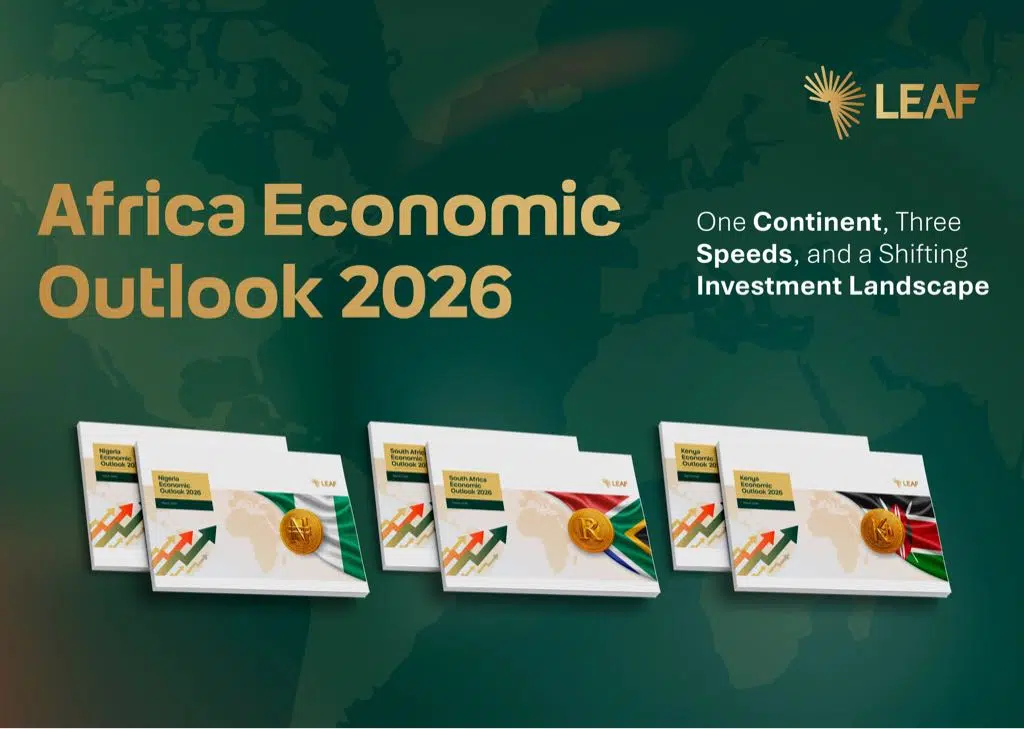
Four reports. One clearer view of Africa's economic direction.
The 2026 outlook is not just about GDP forecasts. It is about the quality of growth, the pressure behind the numbers, and the policy choices that will determine whether economies move from recovery to resilience.
This outlook collection helps investors, policymakers, researchers, operators, and ecosystem leaders understand where momentum is building, where risks are rising, and where strategic opportunities may emerge.
Essential signals from LEAF research to guide strategy, track risk, and locate pressure points.
Global real GDP is forecast at 3.1% in 2026, confirming a softer external environment and making domestic policy quality more important for African economies.
Sub-Saharan Africa Economic Outlook 2026 ReportIntra-African trade is projected to reach $209.3 billion in 2026, showing the growing importance of regional demand, continental markets, and trade integration.
Sub-Saharan Africa Economic Outlook 2026 ReportNigeria's inflation is forecast at 23.8% in 2026, keeping pressure on households, business costs, lending conditions, and macroeconomic credibility.
Nigeria Economic Outlook 2026 ReportKenya's outlook remains one of the steadier regional stories, with growth supported by services, ICT, remittances, tourism, and improving macro stability.
Kenya Economic Outlook 2026 ReportSouth Africa's growth outlook remains modest, reflecting gradual recovery but continued constraints from energy, logistics, weak investment, and structural bottlenecks.
South Africa Economic Outlook 2026 ReportNigeria's foreign reserves are projected to rise to about $51.04 billion in 2026, strengthening external buffers while leaving the economy exposed to oil and FX volatility.
Nigeria Economic Outlook 2026 ReportSouth Africa's public debt remains above 70% of GDP, narrowing fiscal space and limiting the state's ability to fund growth-enhancing infrastructure.
South Africa Economic Outlook 2026 ReportKenya entered a monetary easing cycle in 2025, with the Central Bank Rate falling to 9.00%, supporting credit recovery and private-sector activity.
Kenya Economic Outlook 2026 ReportRead the individual outlooks inside the 2026 collection.
Sub-Saharan Africa Economic Outlook 2026
The regional view of growth, inflation, trade, and macro pressure.
The report provides the broad regional frame for understanding the year ahead. It examines how global growth, trade shifts, commodity prices, inflation, exchange rates, and fiscal conditions are shaping the outlook for key African economies.
Nigeria Economic Outlook 2026
A stability-first recovery in a high-pressure economy.
Nigeria enters 2026 at a delicate transition point. The central task is disciplined repair: rebuilding credibility, restoring foreign exchange liquidity, easing inflation, protecting fiscal space, and sustaining reform momentum.
Kenya Economic Outlook 2026
Resilience, stabilisation, and the test of fiscal sustainability.
Kenya's 2026 outlook is shaped by resilience and caution. Services, ICT, tourism, financial services, remittances, and regional trade support growth, while fiscal durability remains the central test.
South Africa Economic Outlook 2026
A reform-dependent recovery in Africa's most industrialised economy.
South Africa's 2026 outlook is cautious but not hopeless. The economy has stabilised, inflation is moderating, and the country retains a diversified base, but growth remains below potential.
The 2026 story is uneven, policy-sensitive, and reform-led.
Africa's 2026 outlook is uneven
Kenya shows relative stability, Nigeria is managing a difficult transition, South Africa is constrained by structural bottlenecks, and Sub-Saharan Africa faces a softer global environment.
Domestic policy quality matters more
Global conditions are less supportive, which means domestic reforms, policy credibility, and execution capacity will matter more in 2026.
Inflation remains a major dividing line
Kenya and South Africa are closer to price stability, while Nigeria continues to face higher inflation and a harder environment for households and firms.
Fiscal space is under pressure
Governments must balance growth support with debt sustainability, revenue mobilisation, and spending discipline.
Structural reform is now the growth engine
Energy, logistics, trade competitiveness, tax systems, private-sector credit, industrial depth, and productivity will determine whether growth becomes durable.
Built for people making serious decisions.
- Investors assessing market risk and opportunity.
- Policymakers shaping fiscal, monetary, and structural reform decisions.
- Development partners tracking regional resilience and vulnerability.
- Founders and operators planning expansion across African markets.
- Researchers, analysts, professional service firms, media, and ecosystem leaders seeking data-backed African economic insight.
For investors
Understand country-specific risks, growth signals, currency exposure, inflation pressure, and reform momentum.
For policymakers
Compare fiscal conditions, identify structural constraints, and understand the policy levers required for stronger resilience.
For operators
Plan market entry, expansion, pricing, hiring, capital allocation, and risk management.
For researchers
Use the reports as a structured base for macroeconomic analysis, sector commentary, and country-level interpretation.
Featured InsightThe 2026 question is not simply which economy will grow. The deeper question is which economies can convert growth into resilience, investment, jobs, revenue, and long-term competitiveness.
Download the 2026 Economic Outlook Collection.
Explore LEAF Africa's 2026 outlook reports and gain a clearer view of the forces shaping Sub-Saharan Africa, Nigeria, Kenya, and South Africa.
Each report is built to help decision-makers understand risk, locate opportunity, and track the policy and market signals that matter.
Stay ahead of Africa's economic shifts.
LEAF Africa produces research, intelligence, and data-driven insight for investors, entrepreneurs, policymakers, and ecosystem leaders shaping the continent's future.
Source reports: Sub-Saharan Africa Economic Outlook 2026, Nigeria Economic Outlook 2026, Kenya Economic Outlook 2026, and South Africa Economic Outlook 2026.