

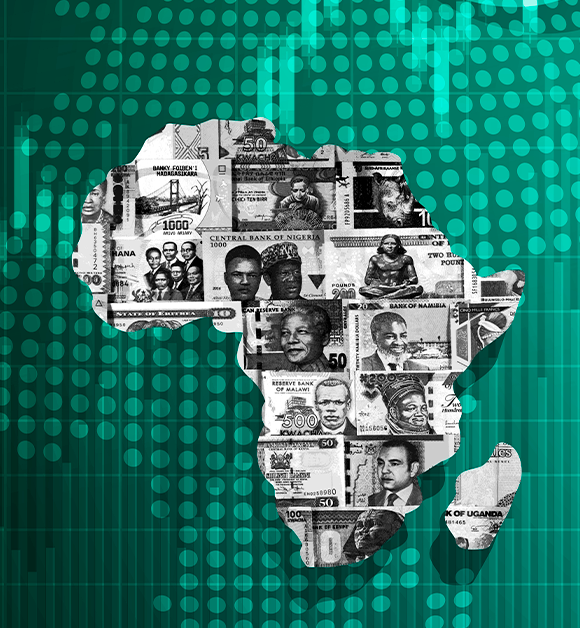
Africa Is Not Moving in one direction.
Africa’s economy is often discussed as a single story. The story in 2026 tells a very different narrative.
Across the continent, growth is diverging, policy paths are separating, and investment opportunities are becoming more nuanced. Nowhere is this more evident than in three of Africa’s most important economies: Kenya, Nigeria, and South Africa.
Each country has entered 2026 from a different starting point. Each is responding differently to global pressures. And each presents a distinct opportunity for investors, policymakers, and businesses.
The message is clear:
Africa is not one market. It is a collection of different economic journeys unfolding at the same time.
The Global Backdrop: A Tougher Environment for Emerging Markets
Sub-Saharan Africa’s outlook in 2026 is shaped by a more demanding global environment marked by:
• Slowing global growth
• Uneven commodity prices
• Tightened financial conditions driven by a strong U.S. dollar
• Rising external financing costs
These conditions are increasing pressure on currencies, inflation, and fiscal stability across emerging markets.
Yet, despite these headwinds, Africa continues to demonstrate resilience.
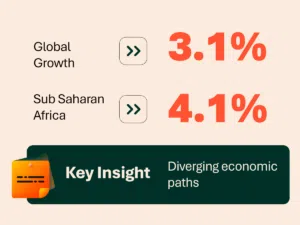
Growth across Sub-Saharan Africa is projected at around 4.1%, outperforming many advanced economies. But beneath that headline number lies a more important story: performance is uneven, and outcomes are increasingly determined by domestic policy strength and structural resilience.
Kenya: Stability, Services, and Sustained Growth Momentum
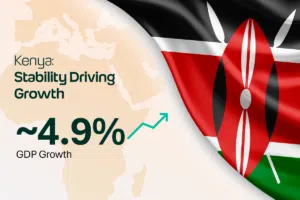
Kenya stands out in 2026 as one of Africa’s most stable and consistent performers.
Growth Outlook
• Projected GDP growth: ~4.5% (Revised by the IMF in April 2026)
• Growth supported by services, ICT, tourism, and domestic demand.
Kenya’s economy has shown resilience following external shocks, including drought and global instability. Growth has stabilised around the 5% range, driven by diversification across sectors.
Key Strengths
1. Diversified Economic Base
Unlike commodity-dependent economies, Kenya’s growth is powered by:
• Financial services
• ICT (Silicon Savannah)
• Tourism
• Regional trade
2. Improving Macroeconomic Stability
• Stabilising the exchange rate
• Strengthening foreign reserves
• Easing inflation pressures
3. Regional Gateway Position
Kenya continues to function as a gateway to East Africa, benefiting from trade integration
within the East African Community.
Risks to Watch
• Weather-related shocks (agriculture dependency)
• Fiscal pressures
• Political cycle uncertainties
Investment Insight
Kenya represents a stability-driven growth market, ideal for investors seeking:
• Predictable expansion
• Strong services sector exposure
• Long-term structural growth
This downward revision from previous estimates is driven by increased energy costs, disrupted remittances, and reduced exports stemming from conflicts in the Middle East.
Nigeria: Reform, Recovery, and Conditional Stability
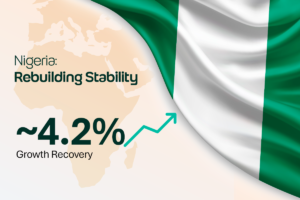
Nigeria entered the year 2026 at a critical turning point.
The country is no longer in crisis, but it has not yet fully stabilised.
Growth Outlook
• Projected GDP growth: ~4.1% (Revised by the IMF in April 2026)
• Recovery driven largely by the non-oil economy
Nigeria’s economic story is not about rapid expansion. It is about repair, stabilisation, and rebuilding confidence.
Key Dynamics
1. Transition from Fragility to Resilience
The next phase of Nigeria’s economy depends on:
• Policy consistency
• Fiscal discipline
• Exchange rate stability
• Inflation control
2. Strong Non-Oil Economy
• Non-oil sector accounts for over 97% of GDP
• Services dominate, contributing over 55% of output
3. Improving Macroeconomic Signals
• Inflation has moderated significantly
• Exchange rate volatility is easing
• External reserves are strengthening
Core Challenge
Nigeria’s growth is still consumption-driven, with weak investment levels limiting long-term expansion potential.
Risks to Watch
• Currency volatility
• Inflation pressures
• Oil production instability
• Fiscal constraints
Investment Insight
Nigeria is a high-risk, high-potential reform story.
For investors, the opportunity lies in:
• Entering early in a recovery cycle
• Targeting sectors driven by domestic demand
• Positioning ahead of full macro stabilisation
Revised due to the conflict in the Middle East and the ripple effects on the Nigerian economy. This highlights a critical shift: Nigeria’s resilience is increasingly coming from services, telecoms, and trade, not oil.
South Africa: Structural Constraints and Reform-Driven Upside
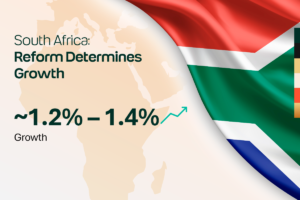
South Africa presents a different picture: a mature economy facing structural limitations.
Growth Outlook
• Projected GDP growth: ~1.2% to 1.4% (Revised to 1.0% in April 2026 by the IMF)3
• Below potential growth of ~2%+
Growth remains modest, constrained by longstanding structural challenges.
Key Constraints
1. Energy Crisis
• Persistent electricity shortages (Eskom load-shedding challenges)
• Major drag on industrial output and investor confidence
2. Logistics Inefficiencies
• Weak transport infrastructure
• Port congestion affecting trade competitiveness
3. Fiscal Pressure
• Public debt above 70% of GDP
• Rising debt-service costs are limiting government spending
4. Weak Private Investment
• Low confidence
• Policy uncertainty
Signs of Resilience
• Moderating inflation
• Strong financial system
Reform Pathway
Growth upside depends heavily on:
• Energy sector reforms
• Logistics improvements
• Better governance of state-owned enterprises
• Increased private sector participation.
Investment Insight
South Africa is a reform-dependent recovery story.
The opportunity lies in:
• Identifying sectors that benefit from reform execution
• Positioning ahead of structural improvements
• Leveraging its sophisticated financial markets
This downward adjustment is largely due to global market shocks and economic fallout from the conflict in the Middle East.
• Diversified industrial base
Sub-Saharan Africa: One Region, Diverging Outcomes
Kenya, Nigeria, and South Africa illustrate three distinct models:
|
Country |
Economic Path |
Key Driver |
Investment Profile |
|
Kenya |
Stability-led growth |
Services, ICT, Trade |
Moderate risk, consistent growth |
|
Nigeria |
Reform-driven recovery |
Policy reforms, domestic demand |
High Risk, high upside |
|
South Africa |
Constraint + Reform |
Structural Reform Execution |
Low Growth, Reform Upside |
This divergence highlights a critical shift in African economic analysis:
What This Means for Investors and Policymakers
1. Africa Requires Precision, Not Generalisation
The era of treating Africa as a single investment thesis is over.
2. Policy Quality Is Now the Key Differentiator
Countries that manage:
• Inflation
• Fiscal discipline
• Structural reforms
will outperform consistently.
3. Opportunity Lies in Understanding Differences
The most successful investors in Africa will be those who:
• Understand local market dynamics
• Identify reform cycles early
• Align capital with structural growth sectors
Conclusion: Three Markets, Different Speeds, One
Strategic Imperative
In 2026, Africa is not slowing down.
But it is moving at different speeds.
• Kenya is holding firm
• Nigeria is rebuilding
• South Africa is navigating reform
Each path offers opportunity. Each path carries risk.
The real advantage lies in understanding the difference.
Explore the Full Reports
To gain deeper insights into growth trends, sector opportunities, policy direction, and market risks:
• Kenya Economic Outlook 2026
• Nigeria Economic Outlook 2026
• South Africa Economic Outlook 2026
• Sub-Saharan Africa Economic Outlook 2026
Final Thought
Africa’s future will not be defined by a single narrative.
It will be shaped by how well each country manages its own path.
And for those paying attention, that is where the real opportunity lies.
US-Iran Peace Deal: Africa’s Economic Test
The U.S.-Iran peace framework matters for Africa not because it resolves the continent’s structural vulnerabilities, but because it temporarily reprices several global risks to which African economies are…
Continue reading
Share a market signal, question, or useful perspective. You can respond to the article as a whole, or use the "Discuss this section" buttons beside key points to add context.
The discussion space is open. Add a clear observation, a question worth exploring, or a field signal that could help other readers think more sharply.