
 Real Estate Report
Real Estate Investment in Africa
A strategic view of Africa’s $17.6 trillion property market, where urban growth, housing deficits, infrastructure, diaspora capital and new investment models are reshaping the built environment.
Africa’s real estate story is no longer only about buildings. It is about cities expanding, people moving, infrastructure opening new corridors, capital searching for yield, and a continent trying to close major housing and commercial-space gaps.
The Real Estate Investment in Africa Report examines where the market is growing, what is driving demand, where investors can find durable returns, and which risks could weaken otherwise attractive opportunities.
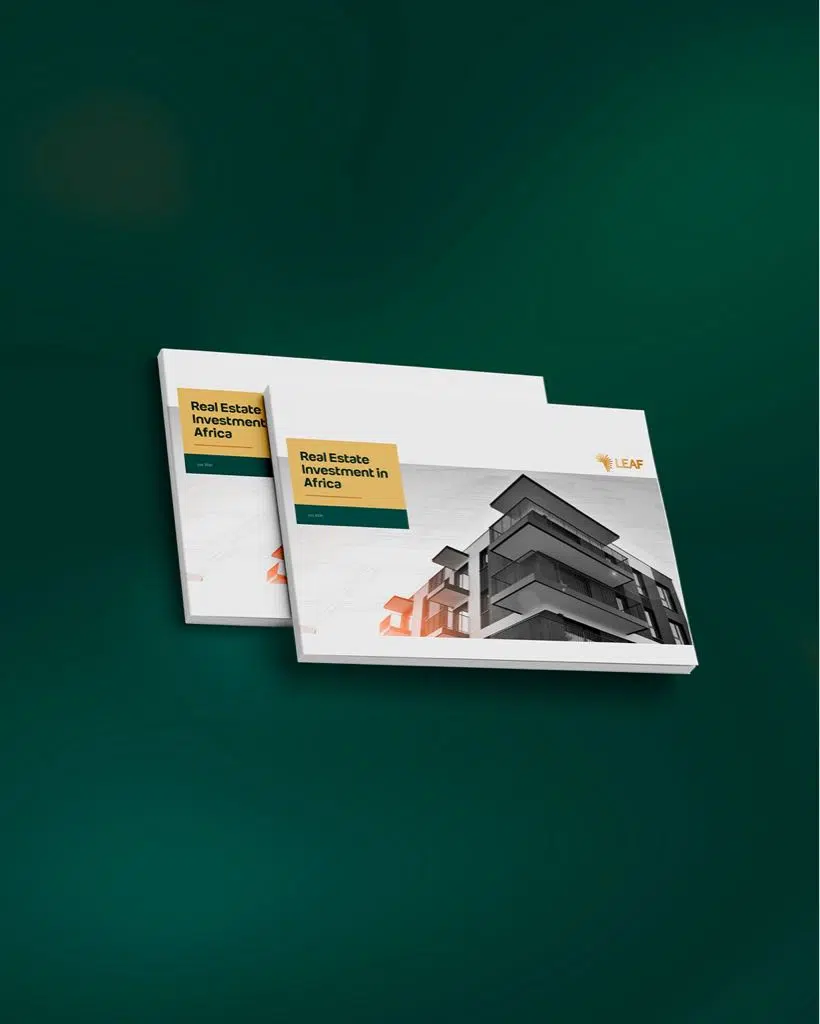
A closer look at Africa’s property market.
A flagship LEAF report built to help investors, developers, policymakers, operators, researchers and ecosystem leaders understand Africa’s rapidly evolving real estate market.
The report goes beyond property prices. It examines market size, housing deficits, urbanisation, rental yields, infrastructure corridors, diaspora capital, investment segments, legal risks, market overheating, REITs, PropTech and the future of African real estate.
Africa’s real estate opportunity is large, but it is not uniform.
Demand is building on several fronts at once.
The continent is urbanising rapidly. Housing shortages remain severe. Infrastructure is creating new development corridors. Diaspora capital continues to enter property markets, e-commerce is increasing demand for logistics space, and digital growth is creating entirely new requirements such as data centres and technology parks.
But strong demand does not make every market attractive.
High-end oversupply, weak mortgage penetration, inflation, FX pressure, title uncertainty, speculative land pricing and regulatory fragmentation can quickly turn apparent opportunity into poor risk-adjusted returns. The question is not whether African real estate is growing, but where demand is structural, where supply is genuinely constrained, and where returns can be sustained.
Essential signals from Africa’s property market.
Use these cards to guide property strategy, track demand and locate the pressure points shaping African real estate.
One of Africa’s largest asset pools
$17.6TAfrica’s real estate market is valued at approximately $17.6 trillion, positioning property as one of the continent’s largest pools of underlying economic value.
Decision signal: property is a structural asset class, not a niche allocation.Faster than any other region
5.58%Africa’s real estate market is projected to grow by approximately 5.58% annually between 2025 and 2029, faster than every other major global region.
Decision signal: the growth premium is real, but it is unevenly distributed.Housing dominates the market
$14.9TResidential property represents approximately $14.9 trillion of Africa’s real estate value, making housing the dominant component of the continent’s property market.
Decision signal: housing is where the weight of the market sits.Nigeria leads
$2.6TNigeria leads Africa’s real estate market with an estimated value of $2.6 trillion, followed by Egypt, Ethiopia and South Africa.
Decision signal: scale is concentrated in a handful of markets.Cities keep absorbing people
60.4%More than 60% of Africans are projected to live in urban areas by 2050, intensifying long-term demand for housing, logistics, retail, offices and infrastructure.
Decision signal: urban demand is a multi-decade trend, not a cycle.Unmet demand at scale
28MNigeria alone faces a housing deficit of approximately 28 million units, highlighting the scale of unmet demand in affordable and mid-market housing.
Decision signal: the shortfall is in affordable stock, not premium stock.Hard-currency demand
$96.4BRemittance inflows into Africa reached approximately $96.4 billion in 2024, providing a powerful source of hard-currency demand for land, housing and property investment.
Decision signal: diaspora buyers are a distinct and durable demand pool.Income potential
10%South Africa records gross rental yields of approximately 10% among the selected markets, followed closely by Zimbabwe, Cameroon and Nigeria.
Decision signal: yield varies sharply by market and by asset class.Warehouses are full
83%Average occupancy in Africa’s modern warehouse market reached approximately 83%, reflecting strong demand from e-commerce, manufacturing and supply-chain expansion.
Decision signal: modern logistics space is genuinely under-supplied.Digital infrastructure gap
450MWAfrica currently hosts only about 450 MW of operational data-centre capacity, while the report estimates that at least another 1,000 MW will be required to keep pace with digital adoption.
Decision signal: digital growth is now a real estate requirement.Near-full occupancy
88-98%Purpose-built student housing in markets such as Lagos and Johannesburg records occupancy levels ranging from approximately 88% to 98%, showing the strength of demand in under-supplied education corridors.
Decision signal: education corridors are a reliable occupancy story.An emerging segment
$1.5BAfrica’s smart-city market is expected to generate approximately $1.5 billion in revenue, with projected annual growth of around 12% through 2029.
Decision signal: early, but growing faster than the wider market.What readers will gain.
Africa’s market at a glance
Understand the size of Africa’s property market, how it compares globally, which countries dominate and why the continent is growing faster than mature real estate regions.
Urbanisation and demographic demand
Explore how Africa’s young population, expanding workforce, household formation and rapid migration into cities are creating sustained demand for residential and commercial space.
Housing deficits
See where the largest housing shortfalls exist and why affordable and mid-market housing may represent one of the continent’s strongest structural opportunities.
Diaspora capital
Understand how billions of dollars in remittances support property purchases, deposits, land acquisition and housing demand across key African markets.
Infrastructure-led growth
See how roads, ports, industrial zones, rail, technology hubs and new infrastructure corridors are repricing land and creating new urban growth nodes.
Real estate and the wider economy
Understand how property development contributes to GDP, construction activity, employment and capital formation across African economies.
Price and rent intelligence
Compare prime residential pricing, rental pressure, affordability and investor dynamics across markets such as Nigeria, Kenya, Ghana, Rwanda and South Africa.
Where investors can win
Explore opportunities across affordable housing, student and build-to-rent housing, logistics, shortlets, data centres and green retrofits.
Yield opportunities
Understand which real estate segments may provide stronger gross yields and why returns differ across markets and asset classes.
Risks and overheating
Identify the warning signs behind high-end oversupply, speculative land prices, weak mortgage access, FX-driven rent inflation and legal or title uncertainty.
Emerging corridors
Examine the investment dynamics shaping Lekki, Kigali, Nairobi and Cape Town and what infrastructure-led development means for future property values.
Future of African real estate
Explore how PropTech, REITs, smart cities, green housing and institutional capital could reshape the property market over the next decade.
Segments where structural demand and market gaps align.
Indicative gross yields drawn from the report’s market analysis.
Deep, unmet demand
6-10%Large housing deficits in Nigeria, Kenya and Ghana create strong underlying demand, particularly for developers that can control construction costs and target workforce and lower-middle-income households.
Under-supplied corridors
10-15%Rapidly growing youth populations, rising university enrolment and severe accommodation shortages create strong occupancy conditions.
Travel-led demand
12-20%Business travel, diaspora visits and tourism support demand in markets such as South Africa, Ghana, Nigeria, Rwanda and Kenya.
Supply-chain expansion
8-12%E-commerce, regional manufacturing and supply-chain expansion are increasing demand for modern warehouses in Nairobi, Lagos and Johannesburg.
Digital infrastructure
15-25%Africa’s digital economy is expanding faster than its physical data infrastructure, creating demand for land, power, fibre and data-centre-ready development.
Repositioning older assets
5-15%Older commercial assets can be repositioned through energy-efficiency upgrades, solar and sustainable building systems. Figure shown is potential NOI uplift.
Growth does not remove risk.
The report treats risk analysis as central to the investment decision, not as an afterthought.
Affordability pressure
Property prices can rise faster than household income, narrowing the pool of buyers a project can realistically serve.
Mortgage constraints
Mortgage-to-GDP ratios remain below 5% in many African markets, limiting how much demand can convert into completed sales.
FX exposure
Currency depreciation can rapidly increase construction costs and distort property pricing.
Luxury oversupply
Some markets have built high-end inventory faster than effective demand can absorb it.
Land speculation
Rising land prices can become disconnected from infrastructure and real end-user demand.
Title and legal uncertainty
Fragmented land-registration and regulatory systems can increase transaction and development risk.
Three forces likely to reshape the next phase.
PropTech
Digital listings, property verification, valuation tools, smart contracts and mortgage platforms can reduce transaction friction and improve transparency.
REITs
Real Estate Investment Trusts can give both institutional and retail investors more liquid access to income-generating property.
Smart and green development
Smart cities, energy-efficient buildings and sustainable infrastructure can improve asset resilience, operating efficiency and long-term value.
The core message
The strongest opportunities emerge where several forces converge: population growth, urbanisation, infrastructure, purchasing power, policy support and genuine supply constraints. Follow demand and productive urban growth rather than simply following rising prices.
Built for people making serious property decisions.
Africa’s real estate opportunity is not simply about buying property. It is about understanding where cities are going.
- Real estate investors evaluating markets, yields, corridors and asset classes.
- Developers determining where unmet demand can support viable residential, logistics, student-housing and mixed-use projects.
- Diaspora investors seeking greater context before purchasing land, housing or income-generating assets.
- Institutional investors assessing REITs, logistics, data centres, green assets and large-scale property opportunities.
- Policymakers designing housing, infrastructure, mortgage and urban-development policy.
- Banks and financial institutions evaluating property finance, mortgage markets and development exposure.
- Researchers, analysts and professional service firms advising on market entry, transactions, development or risk.
Access the full Real Estate Investment in Africa Report.
Get the full report and explore Africa’s real estate opportunity with greater depth, market intelligence and strategic context, covering market size, demand drivers, rental yields, investment segments, infrastructure corridors, housing gaps, risk and the future of African property investment.
Download Full Report