

Africa’s Capital Market Divide:
A Tale of Two Offerings
Africa’s financial markets are entering a defining phase. Large corporations are no longer just seeking capital; they are testing where African corporate value should ultimately be created and owned. Two major players, Dangote Petroleum Refinery and OPay Digital Services, a Chinese-founded, Nigeria-based fintech company, now sit at the center of that debate.
While the Dangote refinery is preparing for a landmark NGX listing, OPay is pursuing a potential U.S. IPO. One is backing the future of African capital markets, while the other is leveraging the depth of global exchanges. Together, both transactions highlight the progress and structural limits of Africa’s evolving financial ecosystem.
Dangote Refinery Listing: Building Domestic Capital Market Credibility
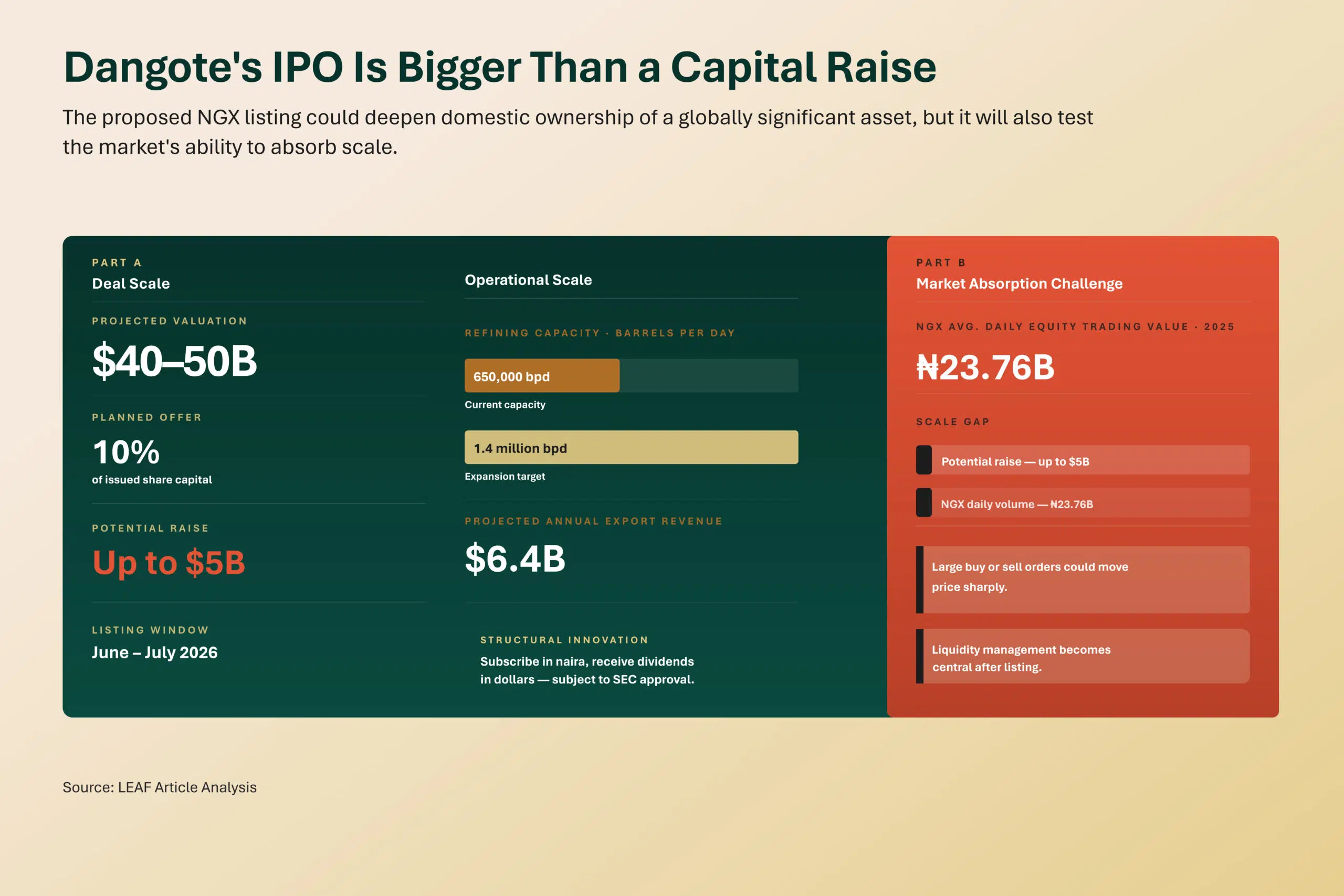
Dangote Petroleum Refinery plans to offer 10% of its projected $40–50 billion valuation, potentially raising up to $5 billion in what could become Nigeria’s largest IPO. Targeted for June–July 2026, the listing is more than a capital raise; it is a test of whether African exchanges can support mega-scale infrastructure assets and deepen domestic investor participation.
With a processing capacity of 650,000 barrels per day, The Dangote refinery is already Africa’s largest refinery and among the world’s largest, with expansion plans targeting 1.4 million barrels per day.
The proposed listing is further distinguished by its export-driven earnings profile. Projected annual export revenue of about $6.4 billion supports a proposed dollar-dividend structure, allowing investors to subscribe to naira while receiving dividends in dollars, subject to SEC approval. If approved, the model could become a major innovation for Nigeria’s capital market, giving local investors indirect access to dollar-linked earnings and creating a framework for future export-oriented African listings.
The Global Context: Scale and Strategic Significance
The Dangote refinery structure is globally distinctive. Unlike multi-site hubs such as Jamnagar or Ruwais, it operates as a continuous single-train refinery, strengthening its strategic relevance in global energy markets. Its planned expansion to 1.4 million barrels per day would place it among the world’s largest refining complexes, reinforcing its position as a globally significant export asset. More importantly, a successful IPO could prove that African exchanges can host globally competitive infrastructure assets while retaining domestic ownership and value creation.
Post-IPO Trading Considerations
Despite its significance, structural market constraints remain a key consideration.
The NGX’s average daily equity trading value of about ₦23.76 billion in 2025 suggests that absorbing a $5 billion float could be slow and potentially volatile. Limited liquidity means large buy or sell orders may significantly affect prices after listing.
While a dollar-dividend structure could boost demand, secondary market depth is still likely to be constrained. For institutional investors, the issue of absorption raises concerns around post-IPO volatility and liquidity management.
OPay: The Foreign Listing Imperative
While Dangote reflects a push toward domestic capital market deepening, OPay illustrates why many African technology firms continue to seek capital abroad.
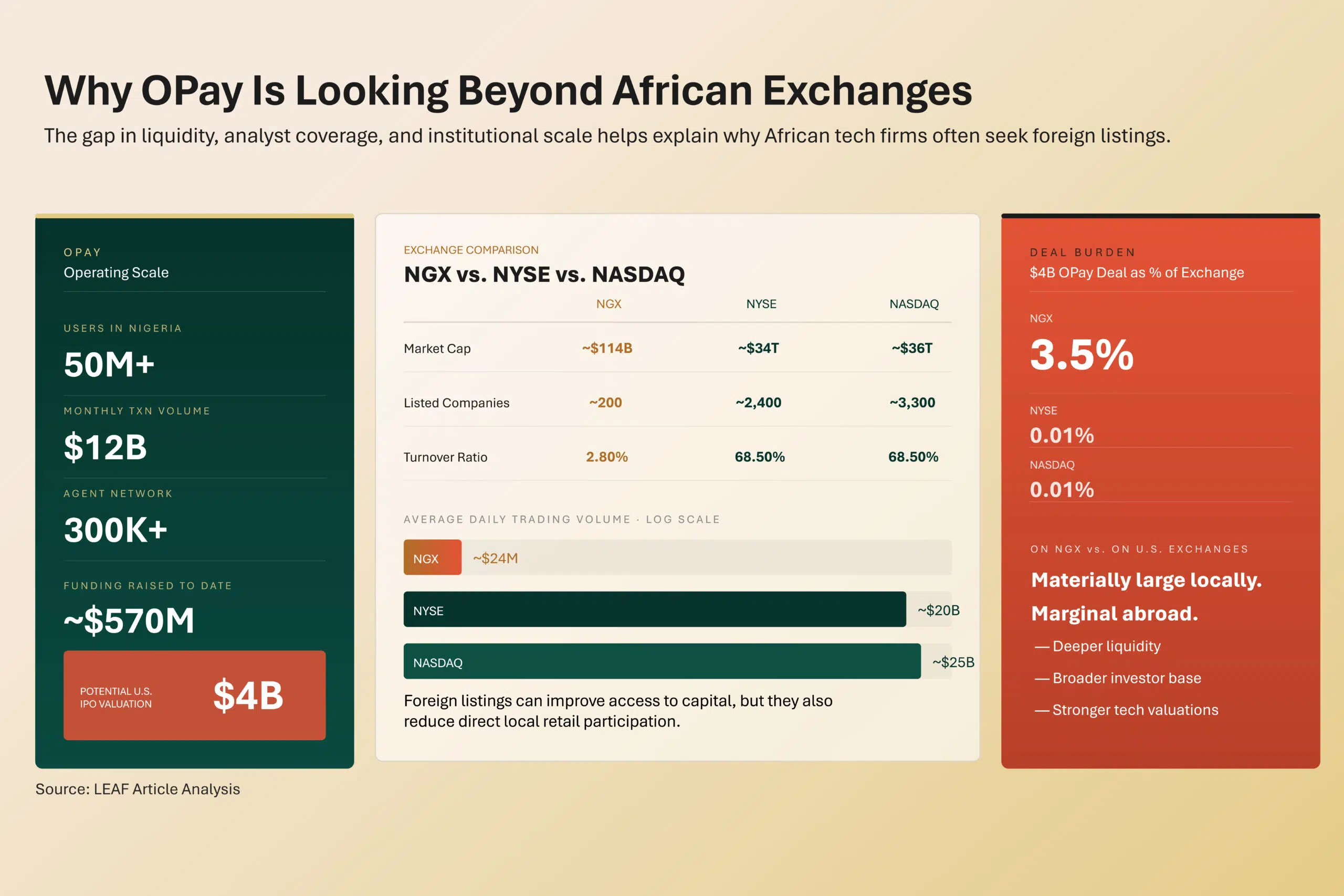
Opay is a Chinese-founded Nigerian company. The fintech company has grown into one of Africa’s largest digital financial ecosystems, with over 50 million users in Nigeria, processing approximately $12 billion in monthly transaction volume as of mid-2025 and supported by a network of more than 300,000 agents. After raising about $570 million in funding, the company is reportedly targeting a potential U.S. IPO at a valuation of $4 billion.
The rationale behind the strategy is straightforward: U.S. exchanges offer deeper liquidity pools, broader institutional investor participation, stronger analyst coverage, and technology-sector valuation multiples that African exchanges currently struggle to provide.
Exchange Market Depth Comparison — NGX, Nigeria vs. US Exchanges (2025–2026)
|
Metric |
NGX – Nigeria |
NYSE – USA |
NASDAQ – USA |
|
Total market capitalization |
~$114 billion |
~$34 trillion |
~$36 trillion |
|
OPay deal (~$4B) as % of exchange |
~3.5%* |
0.01%* |
0.01%* |
|
Approximate listed companies |
~200 |
~2,400 |
~3,300 |
|
Stocks traded, turnover ratio of domestic shares (%) |
2.80% |
68.50% |
68.50% |
|
Market Capitalization (% of GDP) |
21.60% |
216.30% |
216.30% |
|
Average daily trading volume |
~$24M |
~$20B |
~$25B |
|
Subscription currency |
₦ (Nigerian Naira) |
$ (US Dollar) |
$ (US Dollar) |
|
Governance standard |
NGX Premium Board |
US SEC / SOX / GAAP |
US SEC / SOX / GAAP |
Source: Nigerian Exchange Group (Accessed May 2026); World Bank (2026); Securities Industry and Financial Markets Association (SIFMA) Market Metrics (2026); World Federation of Exchanges (2025);TheGlobalEconomy (2026)
Lessons from African Companies on Foreign Exchanges: IPO Performance Snapshot
|
Company |
Exchange & Year |
Current Performance (May 2026) |
|
Jumia Technologies AG |
NYSE, April 2019 |
~42% below IPO price |
|
IHS Towers |
NYSE, October 2021 |
~64% below IPO price |
|
Airtel Africa Plc |
LSE, June 2019 |
405% growth from IPO market cap |
|
Helios Towers Plc |
LSE, October 2019 |
Trading above original IPO valuation |
|
Swvl Holdings |
NASDAQ, March 2022 |
~99% below SPAC valuation |
Source: Bloomberg; Stock Analysis; PitchBook; WeeTracker (2026).
African companies listed abroad have shown mixed outcomes, offering useful context for OPay’s strategy. Airtel Africa and Helios Towers have recorded strong post-listing growth, while firms like Jumia and Swvl faced sharp volatility and valuation declines.
This suggests that foreign listings do not guarantee success. Long-term investor confidence depends on earnings, quality, governance, scalability, and effective management of currency and regulatory risks. For OPay, sustaining strong performance while managing FX exposure and tighter global scrutiny will be central to post-listing investor sentiment.
Investor Implications
For Nigerian retail investors, the Dangote listing offers direct access to a globally significant industrial asset and potential FX-hedged returns if the proposed dollar-dividend structure is approved. However, investors must also consider currency volatility, regulatory uncertainty, and concentration risks within the NGX.
For OPay investors, a U.S. listing offers liquidity, governance transparency, and global institutional exposure. At the same time, it reduces direct participation by local African retail investors, reinforcing the broader tension between market depth and domestic ownership.
Conclusion: Africa’s Capital Market Turning Point
The Dangote Refinery and OPay ultimately represent two strategic paths for African corporate finance. One path focuses on strengthening domestic capital markets and retaining local ownership. The other prioritizes global liquidity, valuation efficiency, and institutional scale.
The success of Dangote’s listing could demonstrate that African exchanges are increasingly capable of supporting mega-scale industrial assets while broadening domestic participation. Success for OPay could validate African fintech on the global stage and attract larger flows of institutional capital into the continent’s technology sector.
Ultimately, the central question is no longer whether African companies can scale. Increasingly, they can.
The more important question is whether African capital markets can evolve quickly enough to finance that growth, retain meaningful ownership, and participate fully in the value being created. The outcomes of these two listings may help determine the answer.
References
African Capital Markets News. 2026. “Dangote Refinery to Be Africa’s Biggest IPO.” Accessed June 1, 2026. https://africancapitalmarketsnews.com/dangote-refinery-to-be-africas-biggest-ipo/.
Bloomberg. 2019. “African Tower Operator Helios Raises $364 Million in London IPO.” October 15, 2019. https://www.bloomberg.com/news/articles/2019-10-15/african-tower-operator-helios-raises-364-million-in-london-ipo.
Bloomberg. 2026. “SoftBank-Backed OPay Hires Citi, Deutsche, JPMorgan for US IPO.” May 1, 2026. https://www.bloomberg.com/news/articles/2026-05-01/softbank-backed-opay-hires-citi-deutsche-jpmorgan-for-us-ipo.
City Different Investments. 2026. “IHS Towers: A Comeback Story for 2026.” January 8, 2026. https://blog.citydifferentinvestments.com/ihs-towers-a-comeback-story-for-2026/.
Dabafinance. 2026. “Dangote Refinery IPO 2026: Everything You Need to Know.” Accessed June 1, 2026. https://dabafinance.com/en/insights/dangote-refinery-ipo-2026-everything-you-need-to-know/.
US-Iran Peace Deal: Africa’s Economic Test
The U.S.-Iran peace framework matters for Africa not because it resolves the continent’s structural vulnerabilities, but because it temporarily reprices several global risks to which African economies are…
Continue reading
Share a market signal, question, or useful perspective. You can respond to the article as a whole, or use the "Discuss this section" buttons beside key points to add context.
The discussion space is open. Add a clear observation, a question worth exploring, or a field signal that could help other readers think more sharply.