


South Africa's 50 Billion Rand AI Economy: Bypassing Physical Constraints for Digital Growth
South Africa’s economy is currently fighting heavy headwinds. With overall economic growth projected at a modest 1.2% to 1.4% percent, the macroeconomic narrative is often dominated by persistent challenges. Inefficient logistics, elevated debt service costs, and repeated bailouts for state owned enterprises like ESKOM continue to restrict productive investment and limit fiscal space.
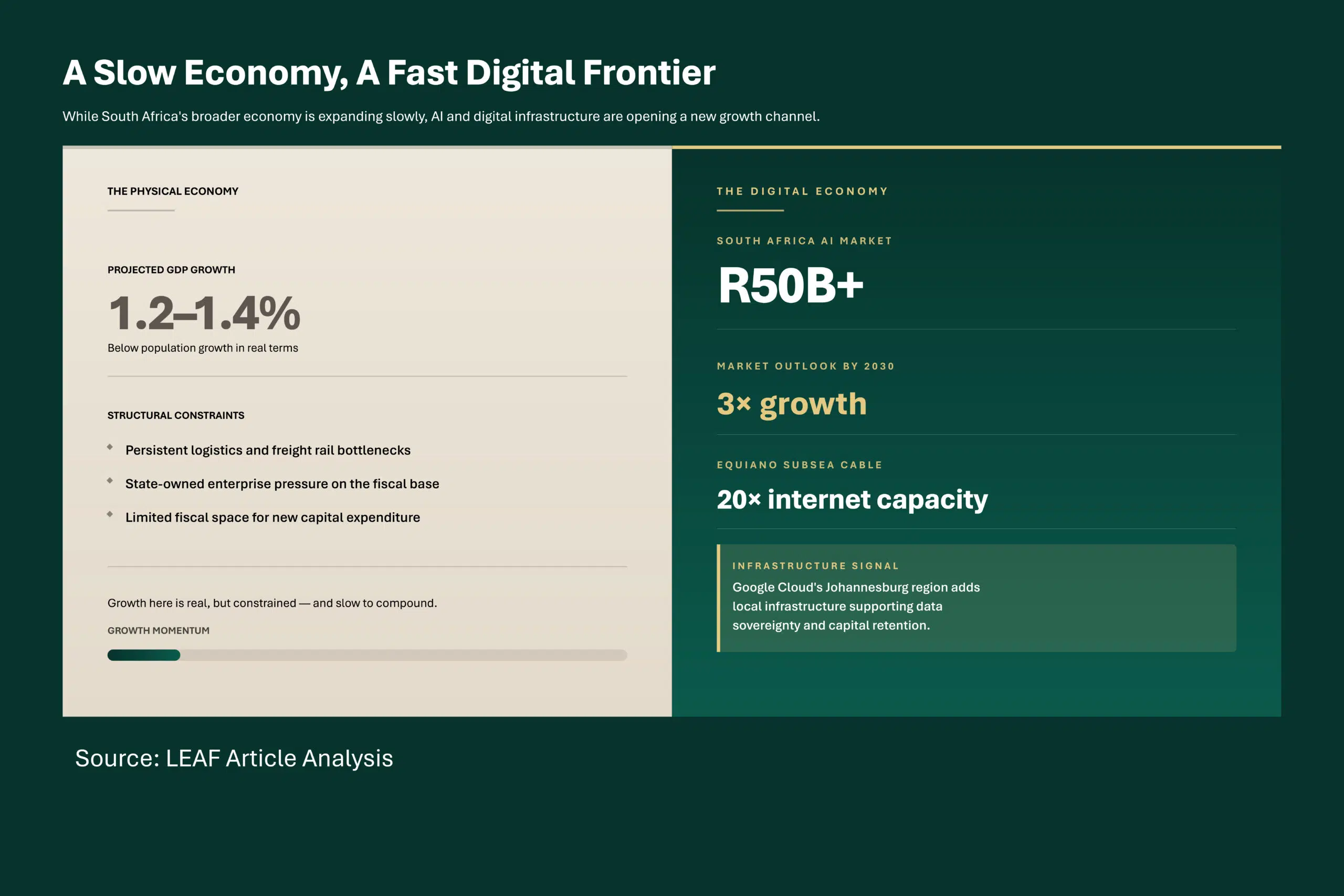
Yet, right in the middle of these physical constraints, a parallel economic reality is emerging. South Africa’s domestic artificial intelligence market is currently valued at over 50 billion Rand and is projected to triple by 2030.
This is not a story about high tech buzzwords. It is a structural shift. The everyday African economy is leveraging digital infrastructure to bypass physical limits, offering serious opportunities for investors who know where to look. The next great African resource is not beneath the soil. It is in the cloud.
Laying the Digital Pipes to Bypass Logistics
Africa’s most industrialized economy struggles with port delays and rail inefficiencies that bottleneck physical trade. Digital trade, however, operates on a completely different matrix.
The deployment of the Equiano subsea cable, stretching from Portugal to Cape Town, has fundamentally altered the connectivity landscape. By multiplying internet capacity 20-fold, this infrastructure delivers cheaper data and instant connections to the global market.
For local enterprises, this means frictionless access to global supply chains and export markets, effectively circumventing the traditional physical logistics hurdles that have long constrained growth.
Sovereign Infrastructure and Capital Retention
For years, African businesses and government agencies had to rent server space in Europe or North America. This reliance on foreign cloud infrastructure exposed local companies to a highly volatile exchange rate and a fluctuating Rand, increasing operational costs unpredictably.
The launch of the Google Johannesburg cloud region changes this dynamic. African governments and startups can now build, store, and secure their digital tools locally.
This provides reliable, sovereign infrastructure that keeps domestic capital working within the local economy while remaining perfectly aligned with South Africa's national data and privacy laws.
Driving Productivity in a High Unemployment Market
South Africa faces elevated unemployment, making job creation and small business survival a critical national priority. However, advanced technology is only an economic driver if the workforce possesses the skills to deploy it.
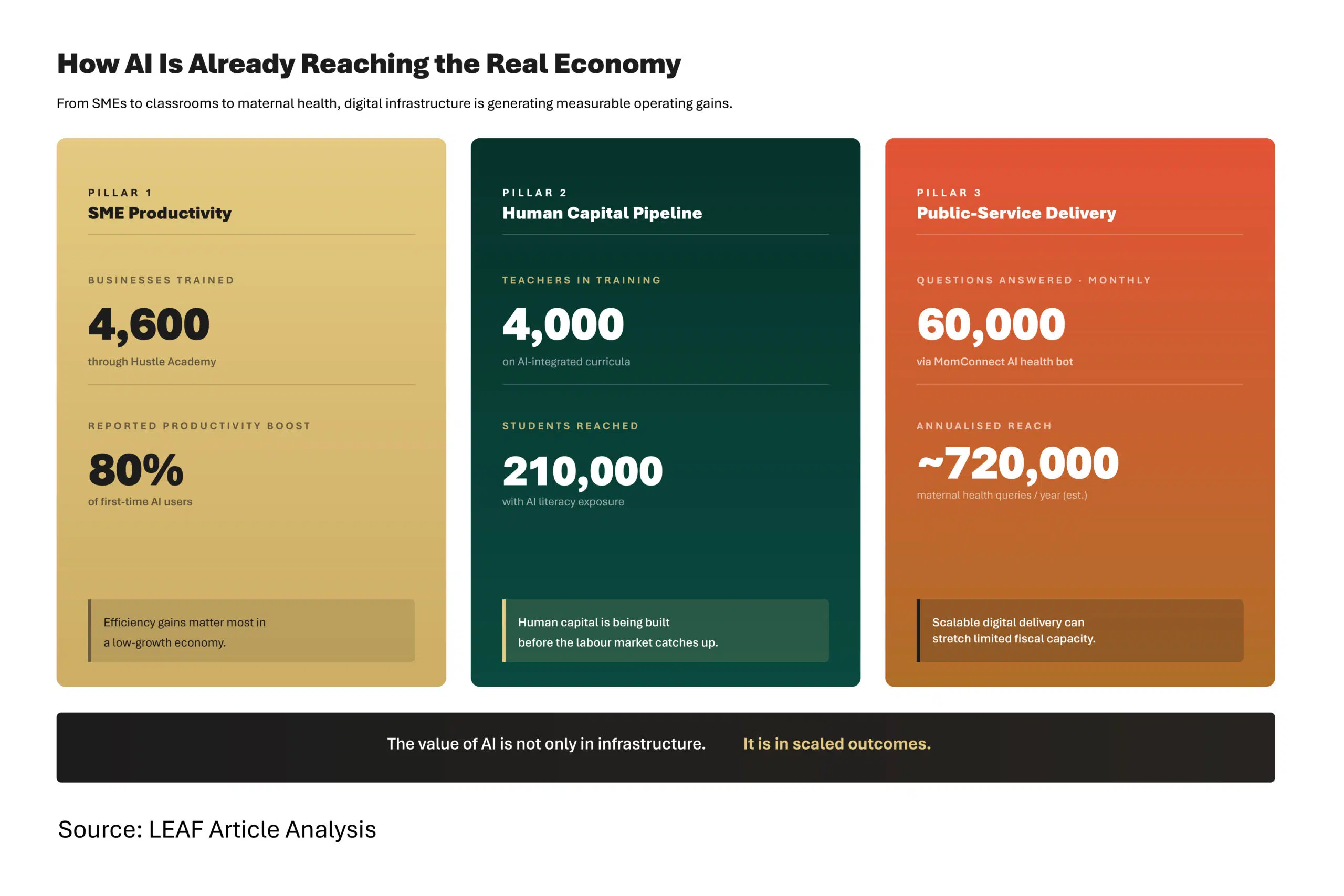
To bridge this gap, initiatives like the Google Hustle Academy have provided over 4,600 small businesses with hands on AI training. The economic impact is immediate and measurable. Among these participants, 80 percent of first-time users reported a direct boost in their daily productivity.
In a constrained macroeconomic environment, targeted digital skills provide small and medium enterprises with the efficiency gains necessary to survive and scale.
Solving Systemic Challenges at Scale
LEAF’s economic reports explicitly identify strengthening human capital as a core requirement for South Africa's long-term sustainability. The digital ecosystem is actively addressing this. A new partnership with the Raspberry Pi Foundation is currently training 4,000 teachers to bring AI literacy to over 210,000 students.
Beyond the classroom, digital infrastructure is solving critical public challenges. Supported by Google.org, the locally built MomConnect AI health bot successfully answers 60,000 questions a month from expecting and new mothers.
When national fiscal space is limited, using scalable digital infrastructure to solve public health and educational challenges efficiently is exactly the kind of innovation the country needs.
Navigate the Frontier of Africa's Digital Economy
South Africa possesses the raw talent to anchor the continent's tech economy. While national structural reforms will take time, the digital ecosystem is moving fast. Get ahead on the frontier and stay informed with actionable insights.
Visit https://leafafrica.org/south-africa-economic-outlook-2026/ to download the LEAF 2026 South Africa Economic Outlook report and get the clear, analytical signals you need to allocate your capital and strategy with confidence.
US-Iran Peace Deal: Africa’s Economic Test
The U.S.-Iran peace framework matters for Africa not because it resolves the continent’s structural vulnerabilities, but because it temporarily reprices several global risks to which African economies are…
Continue reading
Share a market signal, question, or useful perspective. You can respond to the article as a whole, or use the "Discuss this section" buttons beside key points to add context.
The discussion space is open. Add a clear observation, a question worth exploring, or a field signal that could help other readers think more sharply.